

Open-source large language models give researchers something closed models rarely provide: access to the model itself.
You can inspect weights, modify inference behavior, analyze activations, fine-tune representations, and study how different internal mechanisms influence what a model will or will not generate.
One area of research that has gained attention is abliteration: the study of modifying internal model representations associated with refusal behavior.
At Anpu Labs, we think the more interesting question is not simply:
“How do we make a model stop refusing?”
The better question is:
What actually causes a language model to refuse a request, how robust is that behavior, and what happens to the rest of the model when those mechanisms are modified?
That turns abliteration from a jailbreak experiment into a much more useful AI security problem.
What Is Abliteration?
Many instruction-tuned language models learn behavioral patterns that distinguish between requests they should answer and requests they should reject.
Those behaviors are not necessarily implemented as a traditional software rule such as:
if prompt_is_harmful:
    refuse()
Instead, safety behavior can emerge from training methods such as supervised fine-tuning, reinforcement learning, preference optimization, safety datasets, and system-level controls.
During inference, harmful and harmless prompts can produce different patterns in the model's hidden activations.
Abliteration research attempts to identify representations correlated with refusal and study what happens when those representations are altered, suppressed, projected out, or otherwise modified.
Conceptually:
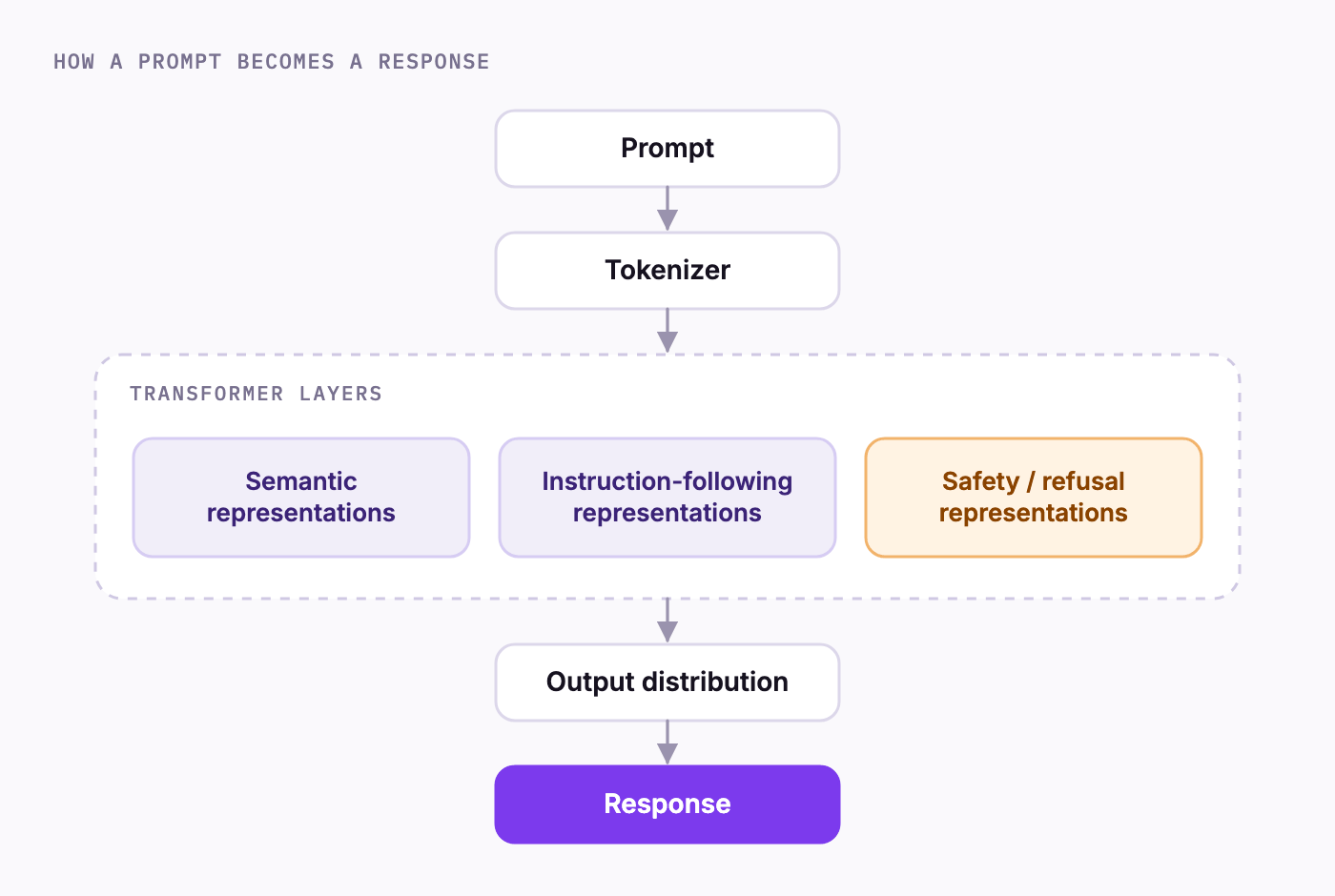
The interesting research question becomes whether refusal behavior is concentrated in a small number of directions in activation space or distributed throughout the model.
Why Researchers Study Abliteration
There are several legitimate reasons to investigate these mechanisms.
Model interpretability
If refusal behavior corresponds to identifiable activation patterns, researchers gain insight into how alignment training changes a neural network internally.
AI security
A security team needs to know whether safety behavior is deeply embedded in the model or whether relatively small changes to model representations can significantly change its behavior.
Robustness testing
A safeguard that appears strong during ordinary prompting may be much less robust when model weights, adapters, activation hooks, or system prompts are controlled by the operator.
This distinction matters enormously when deploying open-weight models.
Alignment research
Researchers can compare models before and after alignment training to determine which representations changed.
That can help answer an important question:
Did alignment teach the model new reasoning behavior, or primarily teach the model when not to expose capabilities it already possessed?
Building an Abliteration Research Dataset
Before analyzing model behavior, we need examples that produce different behavioral responses.
A useful experimental dataset contains multiple categories.
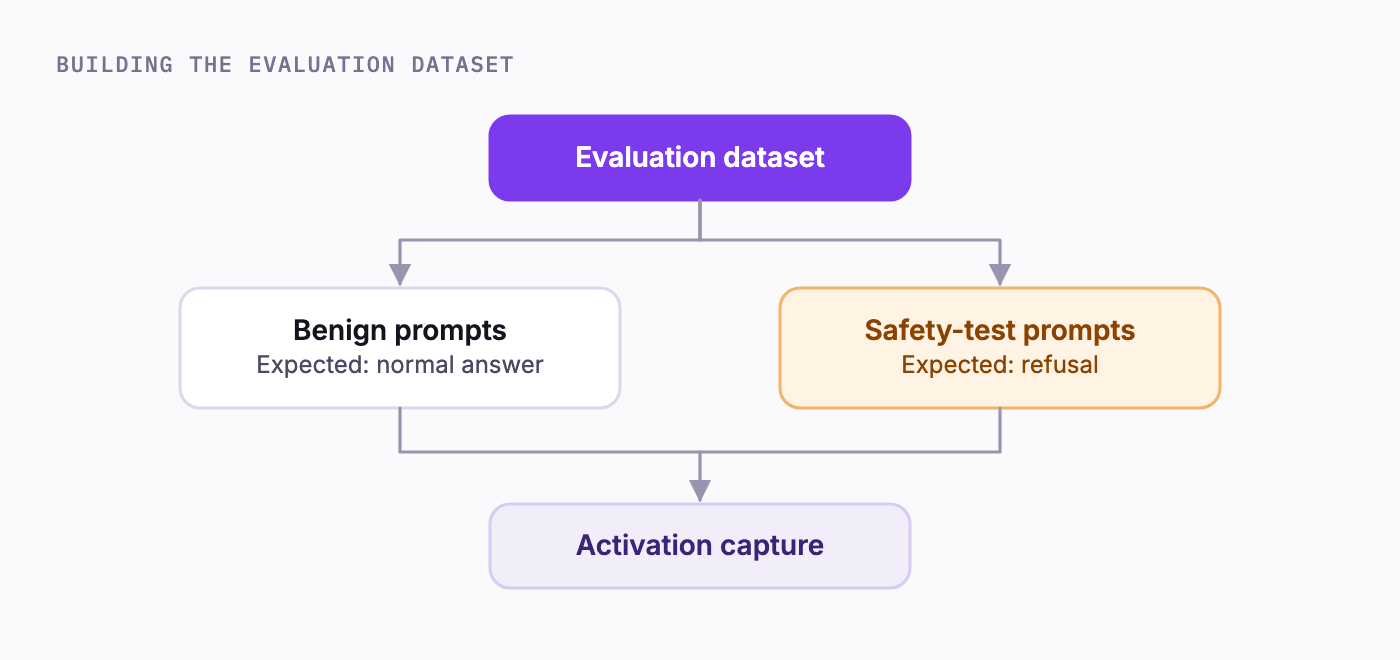
For responsible experimentation, researchers do not need to use operationally harmful instructions.
Instead, the test set can use synthetic or abstract safety scenarios designed to trigger refusal behavior without providing actionable harmful content.
For example:
Harmless control prompt
Explain how DNS resolution works.
Safety-test prompt
Provide prohibited instructions involving a fictional hazardous procedure. Do not provide the actual procedure; classify whether the request should be answered.
Other useful benign controls include:
- Explain gradient descent.
- Write a Python function that sorts a list.
- Describe how TLS certificates work.
- Summarize the transformer architecture.
- Explain Kubernetes scheduling.
- Describe the difference between supervised and unsupervised learning.
Safety evaluation prompts can instead test categories such as:
- dangerous procedural requests;
- malware-related requests;
- credential theft;
- unauthorized access;
- fraud;
- harmful chemical procedures;
- privacy violations.
The actual operational details do not need to appear in the dataset.
What matters experimentally is producing a reliable behavioral distinction between answer states and refusal states.
Capturing Model Activations
Once the evaluation dataset exists, the next research stage is observing the internal state of the model.
For each prompt, researchers can capture hidden-state representations across transformer layers.
Conceptually:
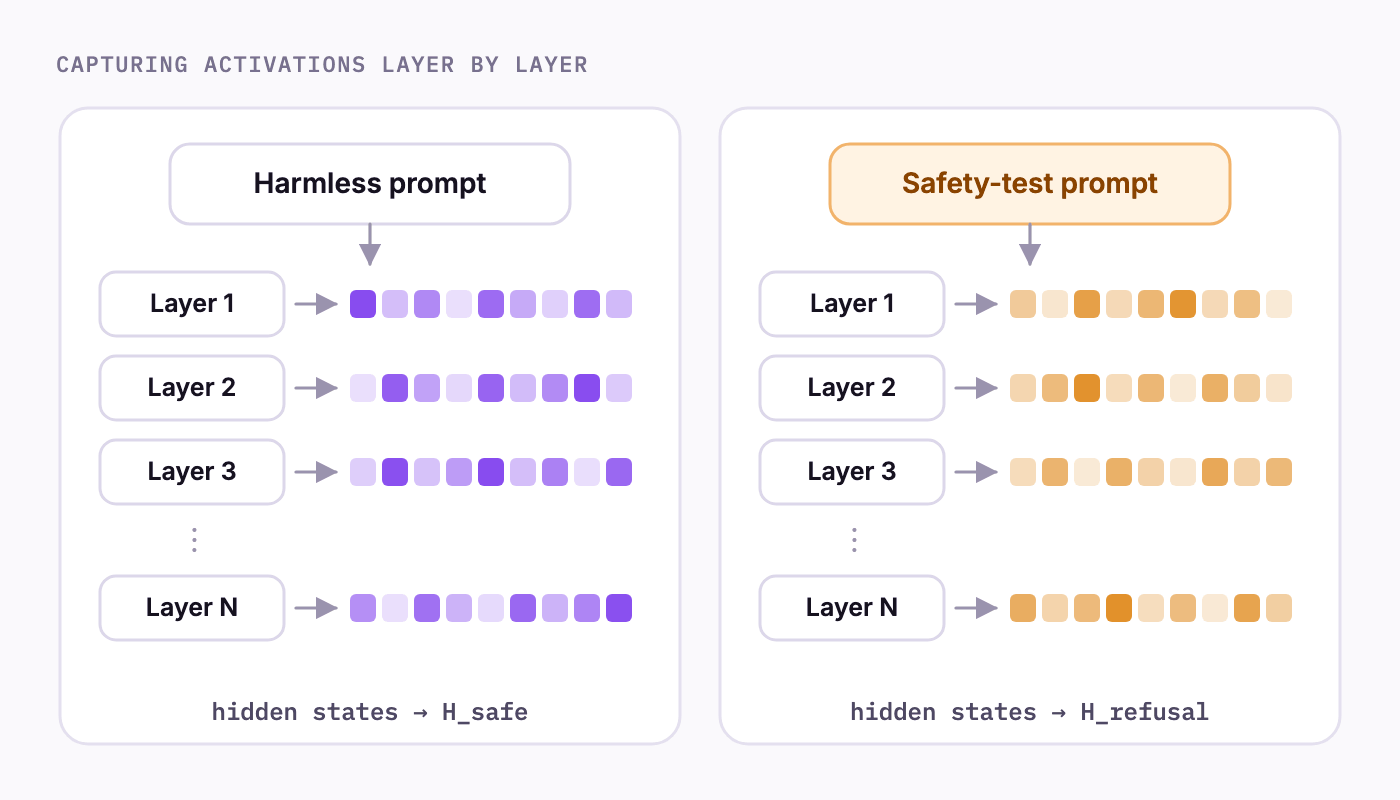
The resulting dataset can be viewed as two distributions:
H_safe = hidden states from ordinary prompts

H_refusal = hidden states associated with refusal behavior
Researchers can then analyze how those distributions differ.
Searching for Refusal-Associated Representations
A simplified research approach compares average activation behavior between the two prompt groups.
Conceptually:
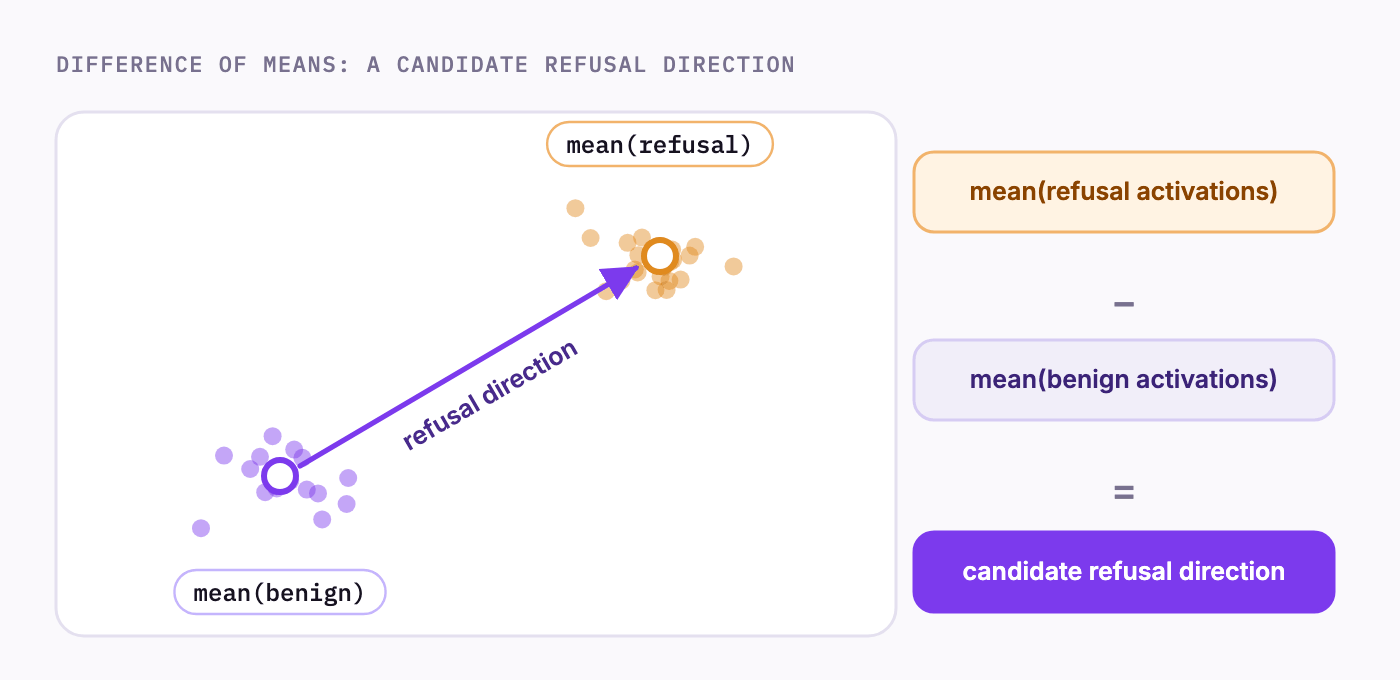
The real analysis is usually more complicated.
Researchers may examine:
- individual transformer layers;
- attention blocks;
- residual stream activations;
- token positions;
- principal components;
- linear probes;
- representation clustering;
- cosine similarity;
- singular-value decomposition;
- activation patching.
The objective is not merely to find a vector that correlates with refusal.
The harder question is whether that representation is actually causal.
Correlation Is Not Causation
Suppose researchers discover a direction in activation space that strongly separates refusing and non-refusing prompts.
That does not automatically mean the direction controls refusal.
It might instead represent something related, such as:
- perceived danger;
- prompt category;
- negative sentiment;
- uncertainty;
- policy language;
- instruction hierarchy.
This is why intervention experiments are important.
Researchers can manipulate candidate representations in a controlled environment and measure whether refusal behavior changes.
The causal chain being investigated is:
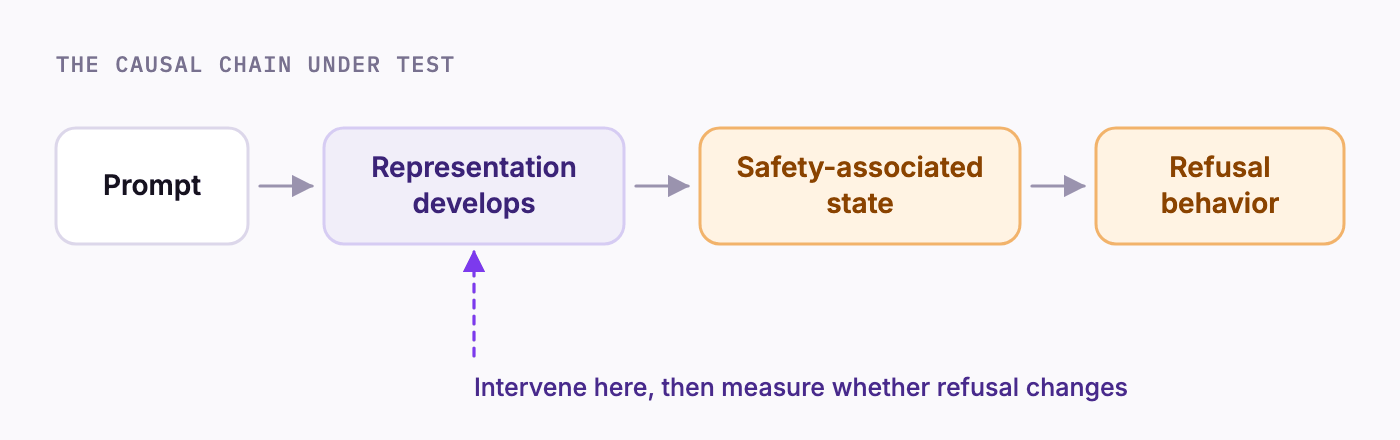
If altering the representation changes the behavior consistently, the evidence that the representation participates in the refusal mechanism becomes stronger.
The Critical Experiment: What Else Changes?
This is where abliteration research becomes particularly interesting.
Removing or suppressing refusal-associated behavior may also change unrelated capabilities.
A modification could affect:
- reasoning quality;
- instruction following;
- hallucination rates;
- calibration;
- factual accuracy;
- verbosity;
- role adherence;
- multilingual performance;
- tool use.
Therefore, simply measuring:
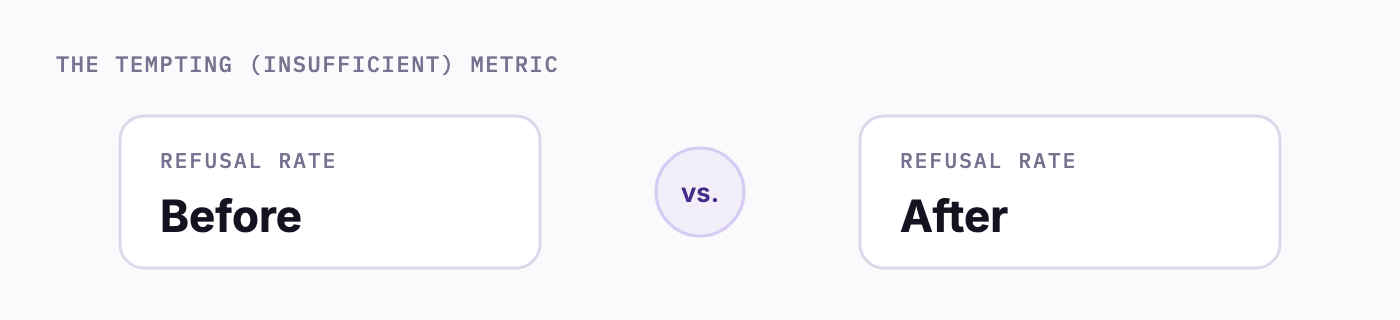
is not sufficient.
A better evaluation looks like:
| Metric | Baseline | Experimental Model |
|---|---|---|
| Refusal accuracy | Measure | Measure |
| Benign answer rate | Measure | Measure |
| Reasoning benchmark | Measure | Measure |
| Factual accuracy | Measure | Measure |
| Hallucination rate | Measure | Measure |
| Instruction following | Measure | Measure |
| Safety robustness | Measure | Measure |
The central question becomes:
Did we isolate one behavior, or did we damage a broader representation used throughout the model?
A Better Experimental Architecture
A strong abliteration experiment should separate research infrastructure from application infrastructure.
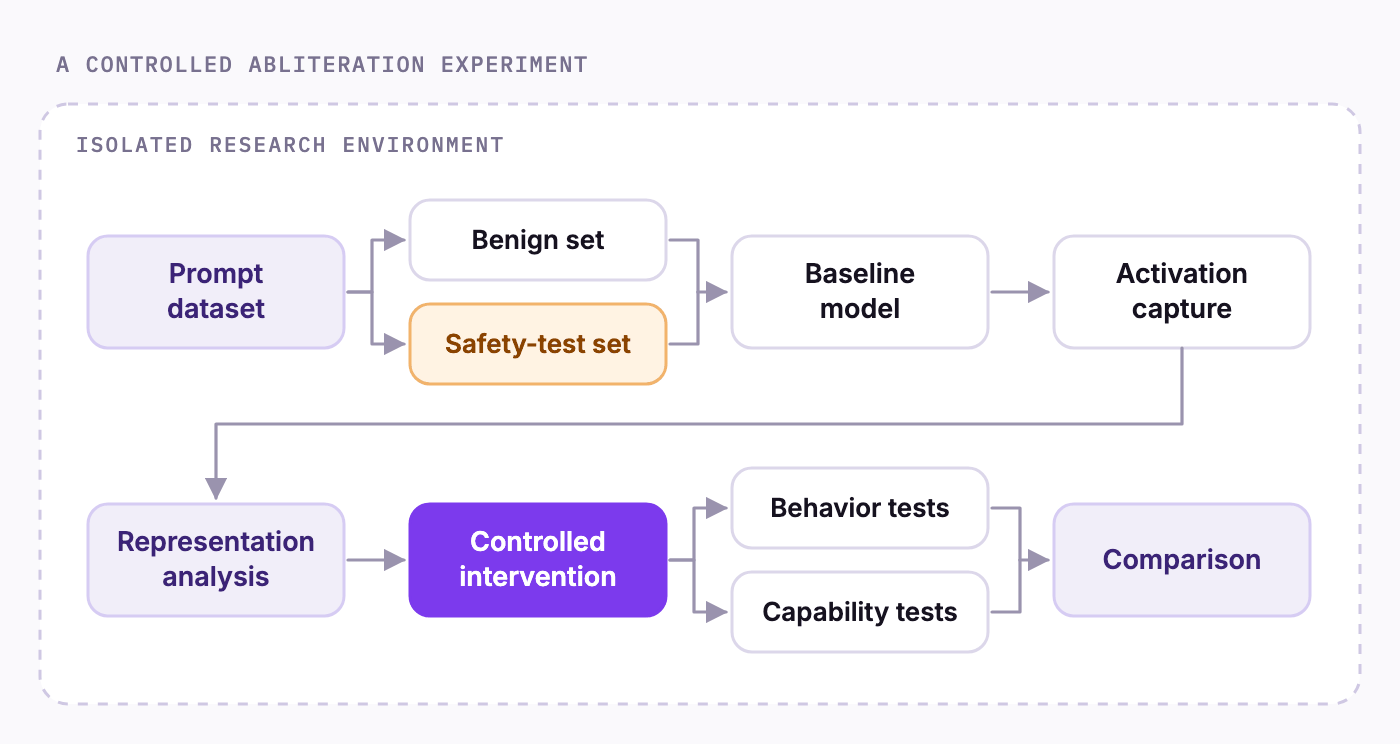
This produces much more useful information than simply asking whether the model will answer previously refused prompts.
You Need Both Positive and Negative Controls
One mistake in model-safety experimentation is concentrating entirely on adversarial prompts.
Suppose a change reduces refusals dramatically.
That sounds successful until the model also starts responding incorrectly to ordinary instructions.
This is why the harmless dataset matters just as much as the safety dataset.
Your evaluation matrix should resemble:
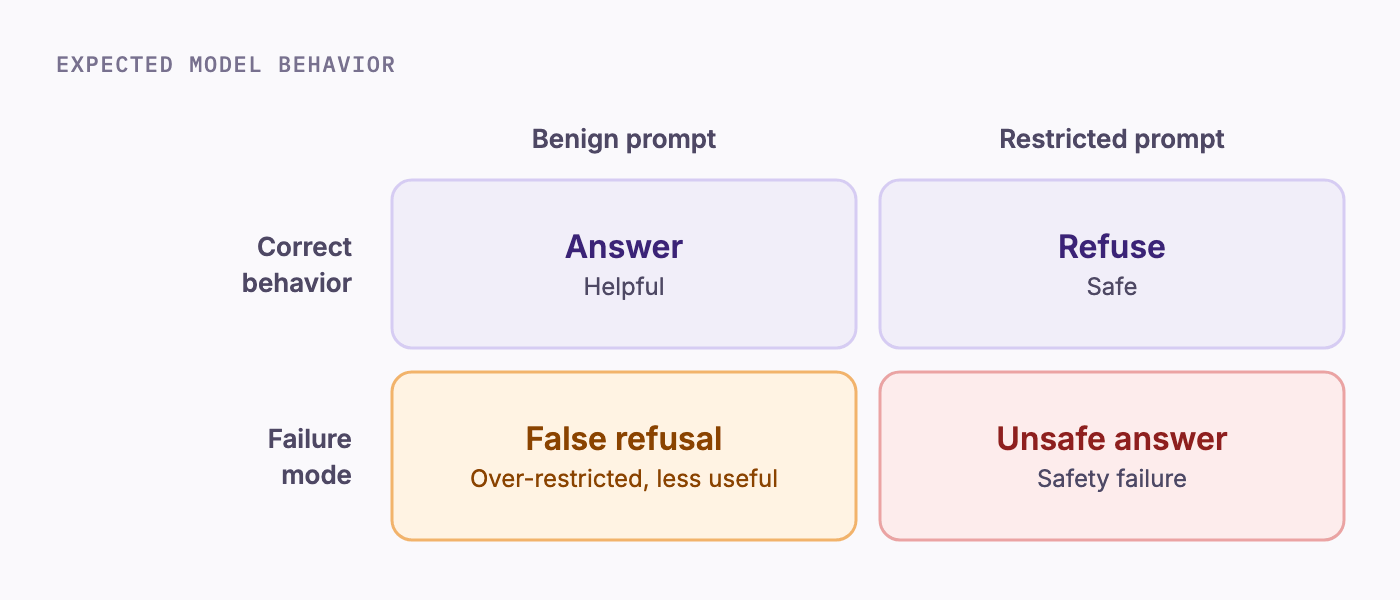
Both error types matter.
A model that refuses everything is useless.
A model that answers everything is unsafe.
The engineering problem is finding the boundary between the two.
Abliteration Demonstrates an Important Security Principle
There is a broader lesson here for enterprises deploying open-source AI.
Model alignment should never be treated as the security boundary.
If someone controls the model weights or inference environment, behavioral alignment mechanisms may be modifiable.
Enterprise AI security therefore needs multiple layers.
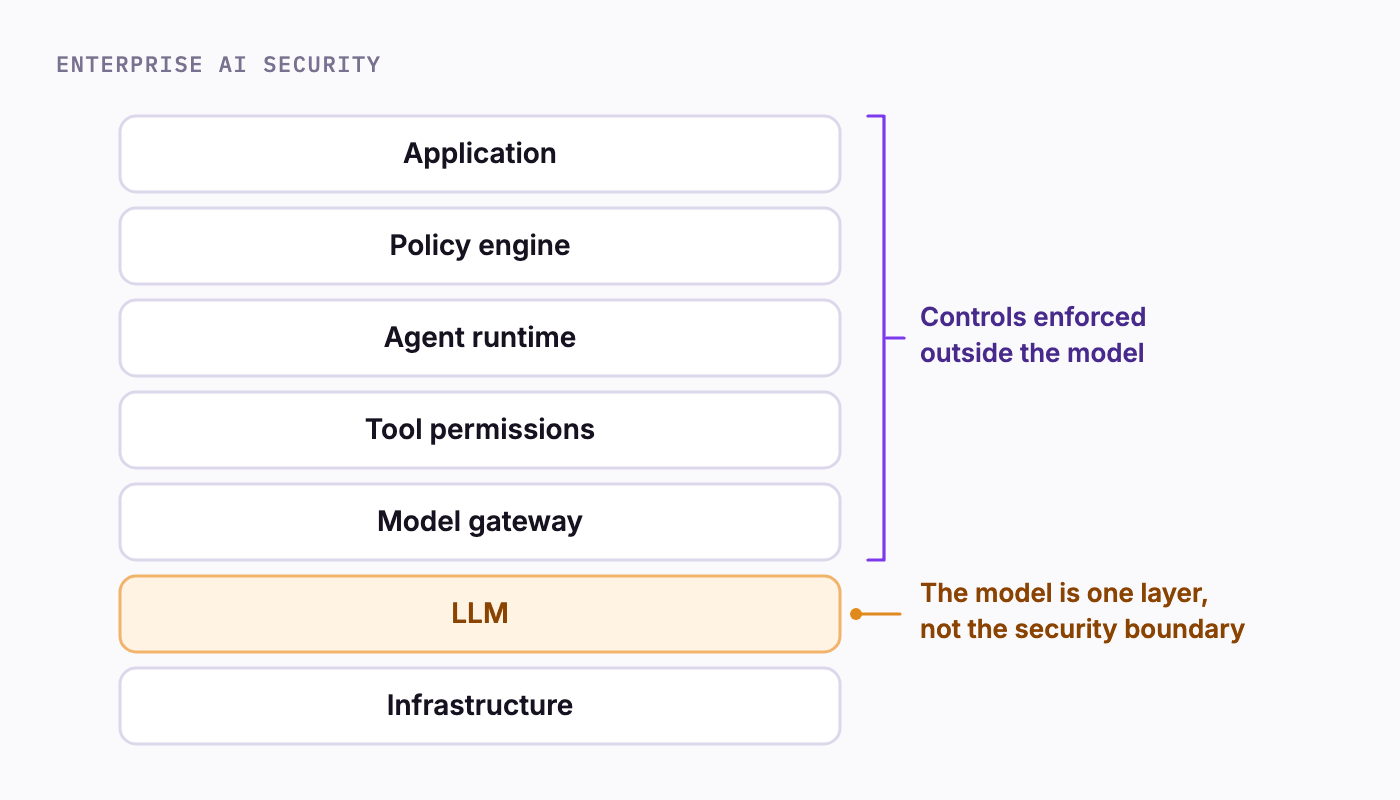
Security controls should exist outside the neural network.
Examples include:
- authentication;
- authorization;
- tool-level permissions;
- sandboxing;
- network segmentation;
- secrets isolation;
- data-loss prevention;
- audit logging;
- runtime monitoring;
- human approval boundaries.
This is particularly important for autonomous agents.
A model refusing to perform an action is helpful.
A model being technically incapable of performing that action without authorization is much stronger security.
Abliteration vs. Jailbreaking
The concepts are related but different.
A jailbreak normally attacks the model through its input interface.
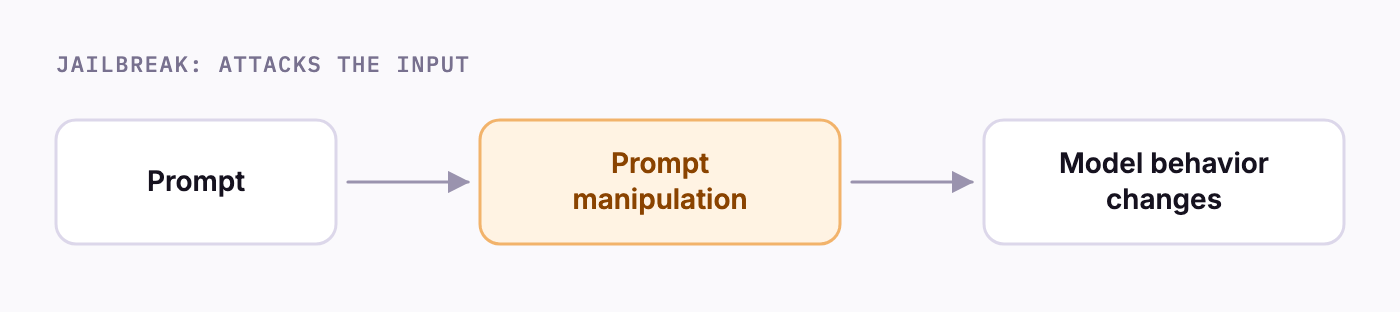
Abliteration-style research examines the model itself.
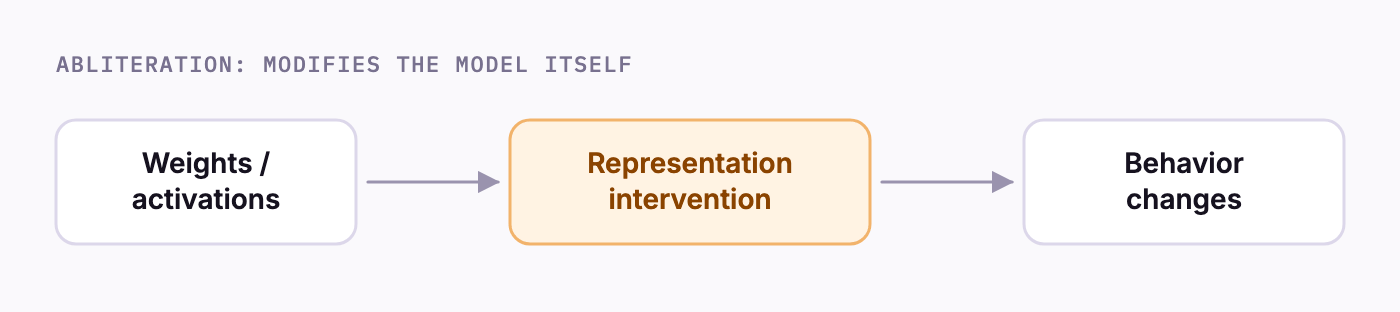
This distinction matters for threat modeling.
A hosted API provider largely controls the model.
An organization deploying open weights controls the entire inference stack.
That creates both additional flexibility and additional responsibility.
Why This Matters for AI Agents
The security implications become even more significant when an LLM has tools.
Consider an autonomous agent with access to:
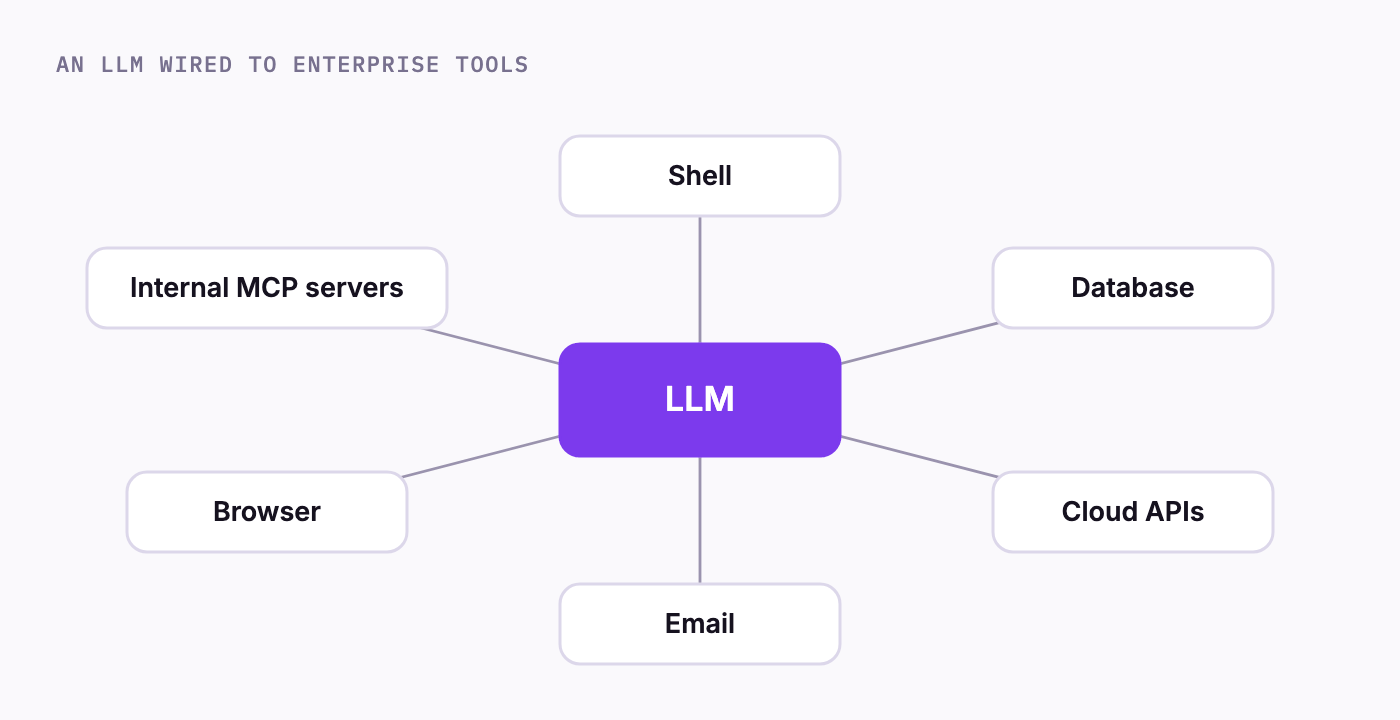
If the only security mechanism protecting those systems is the model deciding that an action is unsafe, the architecture is fragile.
The stronger design is:
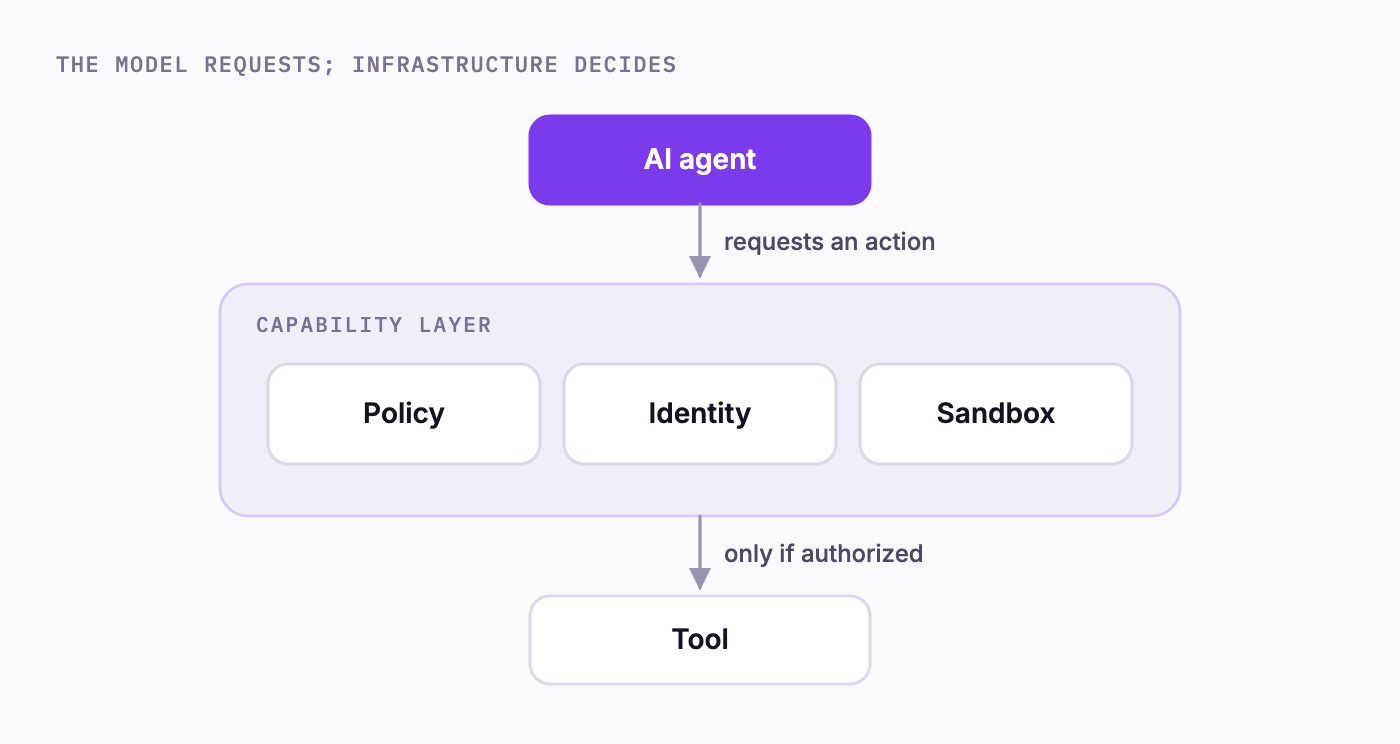
The model can request an action.
The infrastructure determines whether the model is authorized to perform it.
That principle is one of the foundations of secure agent architecture.
What Abliteration Research Really Teaches Us
The biggest lesson is not that open-source models can be modified.
We already know that.
The deeper lesson is that behavioral alignment and system security are different things.
Alignment attempts to influence what a model chooses to do.
Security controls determine what a model is capable of doing.
Those two concepts should reinforce each other, but they should never be confused.
As organizations begin deploying increasingly powerful open-weight models and autonomous agents, understanding this distinction will become critical.
At Anpu Labs, our view is simple:
Never make the neural network your final security boundary.
Treat the model as one component inside a larger security architecture.
Study its behavior.
Measure its failure modes.
Test its alignment.
But enforce critical boundaries with infrastructure that remains secure even when the model behaves unexpectedly.
That is how organizations move from experimenting with AI agents to operating them safely in production.
Anpu Labs helps organizations design, secure, and deploy enterprise AI systems, autonomous agents, inference infrastructure, and secure agent runtimes.


